Showing posts sorted by date for query vickers venom. Sort by relevance Show all posts

Tuesday, 21 March 2023

"COBBER" KAIN & THE CORONATION AIR PAGEANT 1937

 After the last "colourised photo" blogpost, an overdue riposte to restore the Very British balance:

A colourised photograph of F/O Newell "Fanny" Orton and F/O Edgar "Cobber" Kain DFC
relaxing between sorties, France 1940. The RAF uniforms are perhaps a little too blue, rather
than grey/blue, but a noble effort at colourisation all the same. The photograph must post-date
March 1940, as "Cobber" wears his DFC ribbon, awarded in that month. Orton is 'ribbonless"
in this photo, but was to receive his DFC in May 1940, and a bar in July 1940.

The original photograph. In true 1930s Very British style, Orton was raised in
Warwickshire, and Kain in New Zealand. By the end of their campaigns in France,
the two were the highest scoring "aces" of No.73 Squadron, companion to No.1 Squadron
in 67 Wing, Advanced Air Striking Force ("AASF").

Another colourisation - Kain leans against his Hurricane ("Paddy III") in France,  late 1939.
Here, his colourised RAF uniform is "just right".

A popular hero. This edition of "Modern World" dates to 27th April 1940,
with Kain being promoted as "Britain's Air Ace No.1".

Unfortunately, both Kain and Orton would be dead within 18 months of the "colourised photograph" being taken. Kain (aged 21) was killed in a aerobatic accident on 7th June 1940, just as he prepared to leave France for the UK. Orton, wounded on 15th May 1940 when his Hurricane was shot down and thereafter repatriated to the UK before the end of the Battle of France, was subsequently appointed as Squadron Leader of No.54 Squadron and lost (aged 26) in an offensive "sweep" across France by the Hornchurch Wing on 17th September 1941.

And what does all this have to do with the Hereford VBCW, 1938?

Well, before No.73 Squadron flew Hurricanes, the squadron was equipped with Gloster Gladiators (re-equipment seems to have taken place in May 1938, making No.73 one of the earliest RAF squadrons to fly Hurricanes). Flying Gladiators, "Cobber" Kain and 73 Squadron took part in the 1937 Coronation Air Pageant at Hendon. Thankfully (for all VBCW fans) the news cameras were there :  see this stirring Pathe News 1937 Film of the 1937 Coronation Air Pageant, and cross- reference with this alternative version of the same event - another Pathe News 1937 Film. For followers of Edward VIII (then Prince of Wales), you can see him landing and getting out of his plane at the earlier (1934) Hendon Air Display HERE.

We have a very good idea of the "colours and markings" of Cobber Kain's pre-war Gladiator from the Shuttleworth Collection's own Gladiator - still flying above Bedfordshire - repainted in Kain's 1937 Coronation Air Pageant markings (K7985):

Cobber Kain's 1937/1938 Gladiator - Shuttleworth Collection

The same Gladiator was subsequently re-issued by Airfix in "Cobber" Kain's pre-war markings (now OOP, but still available on the 2nd hand market):

The Airfix 1/72 Kit of the Shuttleworth Collection - and therefore Cobber Kain's - pre war Gladiator.

So we know what aircraft "Cobber" would have been flying in 1938 (obviously before re-equipment of his squadron, no doubt delayed by the outbreak of the VBCW), but we have no idea which side, if any, No.73 Squadron would have taken upon the outbreak of "our" Civil War. Still, it is not hard to imagine a young "colonial" like Cain continuing to support "his King" and stunting above Herefordshire, perhaps crossing swords (or machine guns) across the tabletop with Herefordshire's premier aviator, Randolph Trafford, in a 1/72 battle for air supremacy....

Notes:

[1]. "Cobber" Kain's WIKI page is HERE. His body is buried at the Choloy Military Cemetary, near Nancy. "Fanny" Orton's WIKI page is HERE. He has no known grave.

[2]. For the Shuttleworth Collection's WIKI page, see HERE, For the history of the Shuttleworth Collection's Gladiators, see HERE.

[3]. The second Pathe News Film of 1937 contains rare footage [at 3.36 on] of two very new "RAF types" - the Supermarine Spitfire and its "fighter interceptor" competitor, the Vickers Venom.

[4]. For those who insist on the "latest kit" for the VBCW, or wish to meddle in France 1940 wargames, Corgi also issued a (diecast) 1/72 version of "Cobber" Kain's 1940 Hurricane, Paddy III, within their "Aviation Archive" series:


[5]. Add edit - Matchbox's long OOP version of the Gladiator was also issued in No.73 markings, but with number K7984 rather than Cobber's K7985. Still, an ideal companion piece for the 1937 1/72 Coronation Air Pageant!


Thursday, 19 May 2022

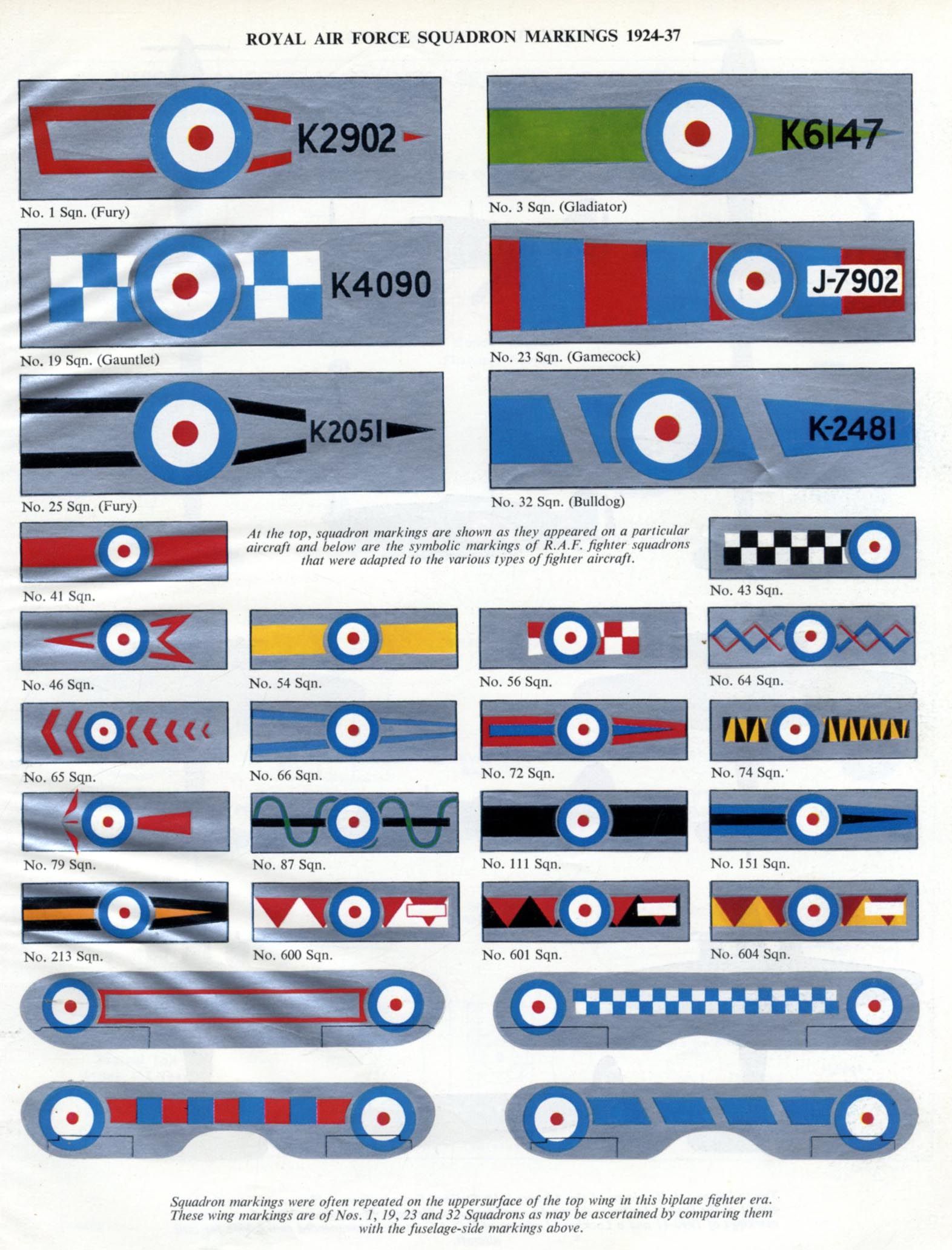
VBCW AIRCRAFT STICKERS (PART THREE) - RAF or BUF SQUADRON MARKINGS

During both the 1930s (pre Munich) and the 1950s (post war), the Royal Air Force loved silvered  and highly decorated aircraft, particularly with distinctive squadron markings along both sides of the fuselage: 

1950s Squadron Markings

Not the VBCW Vickers Venom, but the post war De Havilland Venom.
RAF Squadron Markings.

Back in period - RAF Squadron Markings for the 1938 VBCW

Using the ancient technique of "print carefully and cut even more carefully", these sheets can be used to bring historical colour to VBCW aircraft. Some markings, incorporating national roundels and "flashes", can even be used to decorate the fuselages of BUF aircraft without photoshop amendment:

RAF 617 Squadron - or BUF Air Fleet Marking?


RAF 60 Squadron - or BUF Air Fleet Marking?

Tuesday, 12 April 2022

VBCW AIR WAR - AIRFIX BLOOD RED SKIES

As we wait for the last of the "staff photographers" to wire their Spring Big Game 2022 propaganda battle photographs in to an anxious and over-excited Fleet Street, agog at the news of the Fall of Leominster, a return to VBCW Air Wars and Warlord/Airfix Blood Red Skies "Battle of Britain" boxed set. What's in the box ?

The box. And special dice for the game.

Four Airfix 1/72 kits - 2 x Spitfires and 2 x Me109s. Nice transfers/decals

Some rather nifty "spinning prop" displays, one for each aircraft.

Cardboard cut outs. Barrage balloons and game markers. The other side shows clouds.

More cardboard markers

Trait cards for the aircraft. There are only two in English - the remainder
are in different European languages. The short rules pamphlet is similarly in five languages.

Plastic gubbins for the game, including rulers and turning mechanics

The key to Blood Red Skies. Stands for the aircraft which can swivel into
different postures, conferring the all important "advantage" on aircraft.
There are enough for the 4 aircraft in the game, but the absence of more on
the after-market is a limitation on anyone wanting to fight "bigger games"

The 1/72 Blood Red Skies stands. The interior circular stands are from the original
Blood Red Skies games - the larger ovals have been introduced to allow for the
larger, heavier Airfix 1/72 aircraft. To the right, a Hereford 1938 "Vickers Venom"
with patent home made stand from a Tesco Coffee Pot Lid and bamboo skewer. Gribbly!

First impressions are that the rules are innovative and thankfully short. The anticipated difficulty lies with the aircraft stands themselves - the games rulers and turning mechanics are the same as for the original Warlord Blood Skies game, designed to be used in conjunction with the circular Blood Red Skies stand. The introduction of the "Airfix Oval" sabot base/stand could make manoeuvres "less than optimal". More when the planes finally take to the air.....

Monday, 22 March 2021

HANDLEY PAGE HEREFORD

While the Hereford1938 campaign has been rediscovering the Vickers Venom and even 'disinterring' the Elstree Mongrel day bomber from the VBCW vault, the RAF aircraft most closely associated with the County has been awaiting its own blogpost - the Handley-Page HP53 Hereford "heavy bomber":

Handley Page HP53 Hereford

The Hereford was a variant of the better known Handley Page HP52 Hampden, a twin engine bomber developed by the RAF and Air Ministry from 1936 on, alongside the Armstrong Whitworth Whitley and the Vickers Wellington. Full details HERE. While the Hampden was powered by Bristol Pegasus engines, the Hereford had in-line Napier Dagger engines. A first prototype Hereford flew in June 1937. A production order was placed with Short Brothers and Harland in Belfast, for 100 aircraft, and the first production aircraft flew on 17th May 1939. However, the Napier Dagger engines were its downfall:

"They tended to overheat when used to take off from the grass runways common in the RAF at the time, then cool down too much in the air. Engine failure was too common, and even when the engine worked it was both noisy and high pitched! When the engines worked, performance figures were similar to those for the Hampden, but the engine problems meant that the Hereford never became operational. A small number were used by training units in 1940, but many were converted back to the Hampden standard by swapping the Dagger engines for the more reliable Bristol Pegasus radial engines." [note 1]

None of this, of course was known to modellers at the time. Here is the Hereford on the cover of  the January 1939 edition of "Model Airplane News", a US publication - four months before it went into actual production - and in wholly realistic VBCW colour scheme:


The Hereford in that famous RAF camouflage scheme  - "all over orange"

Although no major kit manufacturer has produced a model of the Handley Page Hereford, Airfix produced a Hampden 1/72 kit in 1968, with relatively regular re-issues over the years until 2010:

Airfix Handley Page Hampden

The February 1969 edition of Airfix Magazine carried an article by Alan W. Hall detailing how an Airfix Hampden could be converted to a Hereford, with a painting and squadron guide:


The conversion was principally centred on re-modelling the shape of the engine nacelles, from the round radials of the Hampden:

Bristol Perseus engines being checked on a Hampden HP52

to the narrower and squarer nacelles of the Hereford:

On the ground - the best place for the Napier Dagger engines of the HP53

which conversion was achieved, back in 1968, by the careful carving of balsa wood, then coating the nacelle shape(s) with "a thick solution of talcum powder and clear dope....left to dry....and then rubbed down with fine sandpaper until smooth"!!

Unfortunately, even the last (2010) production run of the Airfix Hampden now seems rather rare, and prices are therefore ridiculously high. If you're not into talcum powder and dope conversions, the alternative is an equally highly priced kit of a 1/72 Hereford occasionally available from the specialist producer,Valom:


It may therefore be some time before the Handley Page HP53 is spotted in the skies above VBCW Hereford. That may not produce too much difficulty (although some regret) as the Hereford's better known brother, the HP52 Hampden, ultimately proved to be highly vulnerable to German fighters. It was removed from daylight operations as early as December 1939. In short, it seems that the Hampden, likely many 'early war' British bomber designs (cf. the Battle, blogposts passim), was just a bit rubbish and was ultimately to be replaced (along with the Whitley and Wellington, from 1942 on) by the Lancaster. Absent a 1/72 Hereford, the VBCW just seems to be five years ahead of the alternative timeline.

[note 1]: Rickard, J (22 March 2007), Handley Page H.P. 53 Hereford, http://www.historyofwar.org/articles/weapons_hereford.html

Wednesday, 20 January 2021

LIFTING OFF OUT OF LOCKDOWN - RAF

The professionals of the Royal Air Force were not to be left behind in the "2020 Modelling Challenge" ("Aircraft & Anti-Everything"):

"Gloster Gladiators" lined up for inspection. This is the original biplane configuration
of the modelling challenge "piece of cheep Chinese plastic" with a simple paintjob.
In an alternative timeline, interwar silver and colourful heraldry similarly banished,
 this paint scheme would become known as "Munich colours".

A mixed Squadron of 'Gloster Gladiators' and Vickers Venoms. The pressures of the VBCW
often resulted in RAF Squadrons having 'mixed types", much as in early WW1. The Venoms
have the same "cheep Chinese body" as the "Gladiators", with only the second wing
removed. A simple job of finger pressure and a little subsequent cutting/sanding.

A "standing patrol", Venom in the foreground and Gladiator in the rear.
With scientific detection of enemy aircraft still in its infancy, this WW1
tactic for protection of airfields was still much in use during the VBCW.

Vulnerable to attack - Mongrel day-bombers on the ground. The RAF also used
'Blenheims' and 'Battles' as tactical bombers, but were not above adopting the
Mongrel (a favourite of the BUF) when required. More info HERE

An RAF heavy bomber coming into land. Some have tentatively
identified this as a "Lancaster", although in 'other times', this famous
four engined bomber did not enjoy its first flight until January 1941.
Perhaps an example of scientific development being spurred on by Civil War...

A contemporaneous newspaper photograph of the same landing, extracted from
"Our Civil War Illustrated" (pub. Newnes, London 1938). While the headline simply
records "New Bomber Introduced", the article noted "strong local opposition to
engine noise and inconvenience to cattle" with a "vociferous campaign" being
launched by locals "against the planned extension to the airfield's flare path".

Safely down - the Lancaster ("Meng Model Kids") being refuelled by an
RAF Bowser ("Lledo"). A shot to establish relative scale (and how to have
a squadron of heavy bombers in the VBCW without overwhelming the
area of the wargames table)

Light bomber and Heavy bomber - a Mongrel soars over a grounded Lancaster. Another
shot to establish relative scale. Despite their very differing origins (historically and in
terms of plastic and modelling quality), the two types look fine together.

"Instrument check, is it? Engine check, sir!" - a pair of Mongrels joyride
over the airfield. As the VBCW wore on and parts and aviation fuel became
scarcities, such early RAF practices of youthful enthusiasm became
 frowned upon. These two light bombers have to get back soon, anyway..

...ready for that afternoon's full parade. Clockwise from the Lancasters - Gladiators,
Venoms at the fore, Mongrels. The overworked RAF Bowser sits in the middle.

Next up - Red Air Force!

Tuesday, 19 January 2021

LIFTING OFF OUT OF LOCKDOWN - BUF AIRFORCE

Well, at some point we all (in the real world) will get out of lockdown - hopefully in time for a (slightly delayed) Spring Big Game 2021! Back in the world of the Hereford1938 Very British Civil War, the British Union of Fascists have been first to take advantage of the "2020 Modelling Challenge" ("Aircraft and Anti-Everything") with a display of airpower lifting off "at a strategic site out of County", thought to be the Gloster Aircraft Works at Hucclecote, Gloucestershire:

A flight of BUF Vickers Venom interceptor aircraft. The timing and demands of the Civil War 
caused the Venom to be favoured over the more complicated and expensive Spitfire, and 
even the rugged Hurricane. See HERE for an explanation and brief history of this
 iconic - if scarcely remembered - VBCW type.

A full BUF Squadron of Venoms line up for inspection. Vickers turned out hundreds of these 
aircraft over the course of the Civil War. The BUF's pilots were recruited either from
the civil aviation sector, or via the BUF's many "gliding clubs", with a relatively few
senior officers being directly transferred from the RAF (often, but not always, under protest).

A half Squadron of BUF ground attack aircraft - the Mongrel day bomber. Developed by Sir Reginald B'Stard, the
 famous (in his day) aircraft designer, these have been identified as characteristically "square tailed" Mk.II(G) types,
of course indicating manufacture by Messrs. Woolworths & Woolworths of Enfield.
 A potted history of their design can be found HERE


Lift off! Mongrel Day Bombers fly out of Hucclecote Landing Strip.
(Wargamers Note - bases from tops of Tesco coffee jars (small) weighted
with cheap WH Smith modelling clay, stands from bamboo barbecue skewers.
Even these 'cheapskate' bases plus costs of paint came close to being more
expensive than the aircraft models themselves....)

The complete BUF airforce in late afternoon flight (or forest of bamboo skewers).The Mongrel day bombers
take the lead, with 'top cover' being provided by the Vickers Venoms. The two 'weavers' or 'tail end Charlies'
bring up the rear at a slightly higher altitude, as per best RAF early war practice. It is thought that this was
a training flight rather than a battlefield mission.

Next up - the "Red" Air Force and Royal Air Force.....

Wednesday, 17 June 2020

AIRCRAFT (6) VBCW "MONGREL DAY BOMBER"

Our piece of "cheep Chinese plastic", as used in the Modelling Challenge 2020, may be many things (check back on this thread using the label "Aircraft & Anti Everything"), but it is clearly more of an "air superiority fighter/ground attack fighter" than a "bomber". For the purpose of VBCW "air fleets", this posed a significant problem that could only be solved by - well, doubling down with another piece of "cheep Chinese plastic", as purchased from Ebay:
As long as you don't look at the underside of the fuselage, it's, er.....ok. What do you want for 80p inclusive of P&P?
This particularly fine example of the Chinese plastics industry is made of rather softer plastic than our Vickers Venom job, but it is still workable and takes paint kindly enough (over a plastic primer). And it actually "scales" rather nicely with the Vickers Venoms, so all is not at all lost.

But what kind of 1930s plane is it? Originally, it was purchased in the hope that - with its long canopy, elongated nose and single propellor, it would bear a passing resemblance to that wonder of 1930s British Aircraft Industry, the Fairey Battle "day bomber":

Introduced to service in 1936, by 1940 the Fairey Battle was fulfilling its grim role of being shot up by marauding Me 109's (when not being shot down by ground AA fire).
And to a certain extent, it does. But closer examination reveals the horrible truth - the front end and wings appear to be an oversized (and mangled by constant copying over the years) species of Spitfire, while the canopy and tail appear to come from an (equally mangled early variant) Stuka! If this was to be a Fairey Battle, it would be a fairly "bastardized" version! 

Camouflage painting may hide many "problems", but this was time for a more significant intervention : the ever helpful VBCW 'backstory'. Hence can be presented - the Elstree Industries "Mongrel" day bomber (although actual manufacture may have been sub-contracted to Messrs. Woolworths & Woolworths of Enfield) as designed by Elstree's most famous aircraft engineer, Sir Reginald B'stard (knighted in the 1938 Honours List for services to the VBCW aircraft industry). For those unfamiliar with his technical work (quite why he is ignored in almost all the 'history' books, in favour of Camm and Mitchell, remains a mystery), he is probably now best known for being the grandfather of that public spirited Member of Parliament of the 80s and 90s, Alan B'stard:

Alan B'stard MP, grand-son of the VBCW aircraft designer responsible for the Elstree "Mongrel"
The Elstree Mongrel, once introduced into VBCW service, will complement the RAF's existing "heavy transport/bomber" fleet:

This well armed transport was recently seen in action at The Second Battle of Shobdon

A squadron of RAF Heavy Bombers at an airfield "somewhere in the West Midlands".
(The model is a "snaptite egg scale" Lancaster by Meng Kids)