Showing posts with label Ambassadors & Attaches. Show all posts

Tuesday, 16 January 2024

CLIVE OF PERRYSTONE COURT

Now who is this fine military chap ? 

Lt-Gen Sir (George) Sidney Clive, GCVO, KCB CMG, DSO, DL, JP
of Perrystone Court, Herefordshire.

We'd better let his "Who's Who" entry summarise a distinguished career:

Lt-Gen Sir (George) Sidney CLIVE, GCVO., cr. 1937; KCB cr. 1933 (C.B. 1918); CMG 1919; DSO 1915; late Grenadier Guards; Marshall of the Diplomatic Corps, 1935 - 45; b. 16th July 1874; s. of late General Edward Henry Clive and Isabel, d. of  Daniel Hale Webb; m. 1901, Madeline, 2nd d. of late F.W. Huxton M.P.; two s, two d. Educ: Harrow; Sandhurst. Entered Army 1893; Captain, 1900; Major 1909; Maj-Gen 1924, Lt-Gen 1932; passed Staff College 1903 - 1904; General Staff War Office and London District 1905 - 1914; served Nile Expedition, 1898 (two medals, clasp); South Africa 1899 - 1902 (Queens Medal, 5 clasps); European War, 1914 - 1918 (DSO, Bt.-Col, C.B., CMG); Military Governor at Cologne, 1919; Commanding 1st Infantry Brigade, Aldershot 1920; British Military Representative, League of Nations, Geneva, 1920 - 1922; Military Attache to Paris, 1924 - 1927; Director of Personnel Services, War Office 1928 - 1930; Military Secretary to Secretary of State for War, 1930 - 1934; retired pay 1934; a Director of the Royal Academy of Music; President Union Jack Club and Hostel, 1944; Hon F.R.A.M. 1939; Order of St. Stanislaus, 1st Class (Russia); Grand Croix Legion of Honour; Order of the Crown Commander; Croix de Guerre, French and Belgian, J.P., D.L., Herefordshire, High Sheriff County of Herefordshire, 1939. Address: Perrystone Court, Ross, Herefordshire. Clubs: Guards' Brooks's.

Two generations of Grenadier Guardsmen - Sir Sidney with his son, Archer Clive

It appears that Sir Sidney spent much of the Great War as a liaison with French GHQ, which no doubt explains his subsequent quasi political appointments as the British Military Representative to the League of Nations and then Military Attache to Paris (as well as his Legion d'Honneur and Croix de Guerre). But it is his final appointment, as Marshall of the Diplomatic Corps, that brings him into our period of the late 1930s:

Introducing the new German Ambassador to the Court of St. James, 1936.
Behind the sinister figure of von Ribbentrop, a pillar of the British Establishment,
in monocle and ostrich plumed bicorne - Sir Sidney Clive (of Perrystone Court,
 Herefordshire) performing his duties as Marshall of the Diplomatic Corps.

Escape to the country - interior of Sir Clive's Perrystone Court.
Early 20th Century watercolour.

After one final public appointment within the County (as High Sheriff in 1939), Sir Sidney finally retired. It was a long retirement, cut short by tragedy - an appalling house fire on 7th October 1959 that destroyed Perrystone Court and cost "the old Grenadier" his life. From a retrospective piece in the "Hereford Times":

"Sir Sidney had, over the years, looked across from his country house towards the distant Church of St Mary at Ross. On an October day 46 years ago it was the setting for his memorial service. For three centuries the Grenadiers' March had been beaten to mark the return home after a campaign. At St Mary's that day two drummers of the Grenadier Guards, standing in full dress uniform in the north porch, beat out that march to the accompaniment of the organ. Music at the service included an anthem of Sir Sidney's composition, "Whither Thou Goest". All was carried out with pomp and ceremony and military precision - a far cry from the chaotic and grim scenes that had unfolded at Perrystone Court a few days earlier.

Jean Rundell, a nurse living in a flat at Perrystone, was awakened at 5.30 am by her mother who had heard a crackling sound. Looking through a window she could see a rosy glow of fire reflected on trees. Flames and sparks were coming from the morning room window. Perrystone housekeeper Gertrude Enseleit awoke other members of staff in the servants' wing and then ran to the neighbouring Bothy Cottage of air traffic controller Ronald Wilson, shouting `Fire!' and `the General is still in there!' He and his wife tried to enter the mansion but were driven back by dense smoke. But he was not to be defeated and later recalled: "The gardener got a ladder and I went up to the General's room. Down below the morning room was like a torch and the hall was beginning to blaze. I had to make two or three attempts to get across the room before I located General Clive. He was lying on the bed. I dragged him to the window and the people below had got a bigger ladder. Chauffeur Michael Cullum came up with a rope and between us we got it round the General's waist and got him out and down to the ground."

Jean Rundell carried out artificial respiration until the ambulance arrived. En route to hospital the grand old military man died. It was thought that the General's faithful old sheepdog Tony had perished but he was later found asleep on a rug in the housekeeper's room.

Many valuable paintings, including Gainsboroughs, and silver were taken to safety from the house by members of staff. Damage to Perrystone Court - bought by the Clive family in 1865 - was severe. A number of rooms were completely gutted and the roof of the main part of the house had collapsed as had a massive chimney stack which crashed into the middle of the building.

At the inquest later that month South Herefordshire coroner Cyril Shawcross heaped praise on Ronald Wilson for his courage in entering the blazing mansion. He also complimented chauffeur Cullum for his quick-thinking...."

St. Mary's Church, Ross-on-Wye.

Note : Sir Sidney's son, Archer Clive, continued the family tradition. Educated at Harrow and then Sandhurst, he fought with the Grenadier Guards during WW2, being awarded an MC in 1940 and then commanding the 6th Batt., Grenadiers, between 1941 and 1943. Retiring from the Army in 1947 with the rank of Brigadier, he became a Justice of the Peace in Herefordshire and served as Deputy Lieutenant of the County in 1960. He died in March 1995. See his WIKI entry here.

Friday, 12 January 2024

AMBASSADOR RIBBENTROP, 1938 - COLOURISED

Having met Soviet Ambassador Ivan Maisky and United States Ambassador Joe Kennedy, time to continue our tour of the London Diplomatic Corps and pop in on the German Ambassador in 1938, Joachim von Ribbentrop:

von Ribbentrop, German Ambassador to the Court of St. James in 1938.
Suggestions that he was recalled to Berlin in February 1938 in order
to become Foreign Minister of the Third Reich clearly belong to
alternative history.

von Ribbentrop "colourised". Nicely done, but the green shirt
must surely be an error. And the blue pen must be wrong, too.

Von Ribbentrop in "full parade rig". The brown shirt is much better.

And here he is, colourised and finally properly dressed for an Ambassador,
on the steps of the German Embassy in London. For the connection to
Herefordshire, see HERE

Thursday, 11 January 2024

PUBLIC SCHOOLBOY TO PANZER COMMANDER

If there is any doubt as to the general usefulness of public schoolboys in battle, confirmation from an unlikely source - the son of the German Ambassador to the Court of St. James, Joachim von Ribbentrop. In certain timelines, Joachim von Ribbentrop's ambassadorial appointment in England started on 30th October 1936 and finished on 4th February 1938, when he was recalled to Berlin to replace von Neurath as the Third Reich's Foreign Minister. In our VBCW timeline, of course, von Ribbentrop's appointment as ambassador continued throughout 1938.....

But that's as may be. What is certain is the von Ribbentrop brought his sixteen year old son, Rudolf, with him to London, and (after he was rejected by Eton) enrolled him at Westminster School. Rudolf spent a year at Westminster before returning to Germany for his further education [note 1] :

Rudolf von Ribbentrop, 1936. Leaving Eaton Square and
heading towards Westminster School

Upon the outbreak of war in 1939, Rudolf joined the SS Infantry Regiment Deutschland as a private soldier, serving during the Western Campaign in 1940 (where he was wounded) and being awarded the Iron Cross 2nd class:

Rudolf von Ribbentrop with Iron Cross and SS collar flashes.
Probably the only "Westminster old boy" to serve in the SS.

After some recuperation, officer training and time fighting on the Finnish Front (where he was wounded again), by February 1943, Rudolf was serving as a Hauptsturmfuhrer with the newly formed Panzerregiment of the 1st SS Division Leibstandarte SS Adolf Hitler ("LSSAH") at the Third Battle of Kharkov, as a result of which he was awarded the Knight's Cross of the Iron Cross:

A long way from Eaton Square - Rudolf von Ribbentrop in a Panzer IV, Kharkov 1943

On 1st August 1943, Rudolf was transferred as a company commander to the newly formed 12th SS Division Hitlerjugend, and fought with them during the Battle of Normandy, the escape through the Falaise Gap, and the Battle of the Bulge:

Rudolf von Ribbentrop in Normandy 1944. Clearly under significant strain.

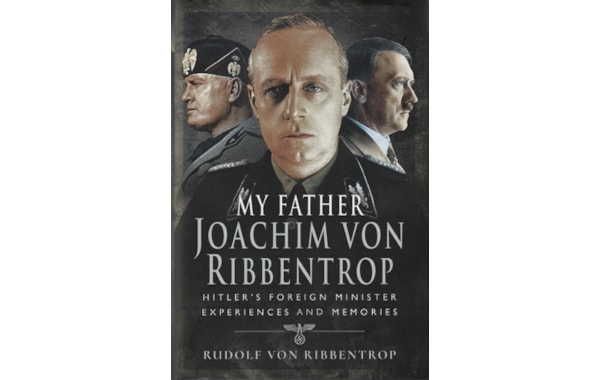
Rudolf surrendered with the Division to the Americans at the end of the war, on 8th May 1945. Post war, he built a career as a wine merchant and banker and latterly published a book about his father, "My Father Joachim von Ribbentrop : Hitler's Foreign Minister, Experiences and Memories". He died on 20th May 2019.

Notes

(1). Peter Ustinov was a contemporary of Rudolf von Ribbentrop at Westminster, and perhaps contributed to Rudolf's departure to Germany after having "sold a story" about him to the London Evening Standard. He wrote in his 1977 memoir, "Dear Me" that Rudolf arrived at school each morning "dressed like the rest of us but with the Nazi Party youth badge - swastika, eagle and all - prominently and incongruously displayed in his lapel." The photographs suggest that he was indeed wearing something on his left lapel....

Another shot of Rudolf von R in Eaton Square, 1936.

(2). For a highly detailed review of Rudolf's WW2 career, see HERE

(3). For the 12th SS Division Hitlerjugend, see HERE

(4). Rudolf's book in English translation (Pen & Swords Books) :

Tuesday, 5 December 2023

THE KENNEDYS, 1938

Unlike the Soviet Ambassador, Ivan Maisky, there is no record of Comrade Colonel Professor Winters having visited the US Ambassador to the Court of St. James in 1938, Joe Kennedy, Snr.

U.S. Ambassador Joe Kennedy Snr., 1938


In 1938, the U.S. Embassy in London moved from 4 Grosvenor Gardens to 1 Grosvenor Square:

A modern photograph of 1 Grosvenor Square. The building was taken over by
the Canadian High Commission in 1960, when the Americans moved to a
new Embassy building, also situated in Grosvenor Square.

The year 1938 therefore saw in a new U.S. Ambassador and a new U.S. Embassy in London. Ambassador Kennedy had also made sure to bring his wife and extensive family to Great Britain:

Ambassador Joe Kennedy Snr on ship to England with his two eldest sons, Joe Jnr. and John Fitzgerald.

JFK, then aged 21, and RFK, then aged 13, at the US Ambassador's luxurious residence,
14 Princes Gate, Kensington (overlooking Hyde Park)

An exercise in wishful thinking - a "Picture Post" cover profile of
 Ambassador Kennedy. Whatever else might be said about "Ol' Joe",
 he was certainly no "Friend of Britain".

American involvement in the VBCW has extended (so far) only to the startling appearance of "General" George Patton as (an informal) "military attache" and (actual) "senior armoured adviser" to the Social Democrats (or Democratic Socialists) of Bromyard (the Independent Republic of) and the (entirely deniable) presence of an "American Snatch Squad" in the City of Hereford itself. There are also strong rumours of an "All-American Air Patrol" coming to the County, but on whose side and in what strength remains to be seen.....

Thursday, 30 November 2023

COMRADE WINTERS LONDON JOURNEY - AMBASSADOR MAISKY

Comrade Colonel Professor Winters finally took the plunge and entered the Soviet Embassy at 13, Kensington Gardens. He was met in the entrance hall by none other than the Soviet Ambassador himself, Ivan Maisky:

Mr Ambassador Maisky, making clear his one allegiance.

Always a resourceful diplomat, Maisky kept this bust of Lenin to hand,
perhaps as an insurance policy in the case of political change in Moscow.

Stalin's purge of the Red Army and Navy, launched in the Summer of 1937, resulted in the liquidation of three out of five marshals of the Red Army, 13 out of 15 army commanders, eight out of nine admirals, 50 out of 57 army corps commanders, 154 out of 186 division commanders, all of the Red Army's senior commissars (16 in total) and 25 out of 28 commissars of army corps. With such a terrible record, Comrade Colonel Professor Winters knew that his chances of survival were slim indeed.

But Maisky was smiling....

Ambassador Maisky at his desk - and smiling.

He could absolutely assure Comrade Winters that Comrade Stalin had no intention of recalling him from his vital command in Herefordshire; the thought of Winters' so-called "liquidation" had never even entered Stalin's mind. To the contrary, Comrade Stalin was his greatest admirer, and looked forward to the day when Winters finally established the mighty Herefordshire Soviet.

A message between Comrades, Stalin to Winters.
Liquidation had never entered his mind, honestly.

As a token of Stalin's esteem, arrangements had been made for certain very heavy weapons to be released from the Red Army's armoury and transported to Presteigne, and Stalin would be happy to hear of Winters' future military intentions...

VBCW Historical Notes

(1). There is still considerable debate in VBCW historical circles as to the reasons why, following the Disaster at Dinmore, Stalin changed his mind about the repatriation and liquidation of Winters. It may have been simply a matter of timing, for there were already strong rumours of an imminent Government counter-offensive in Herefordshire. It may therefore have been thought inadvisable to change Communist leadership at this precise point. There may also have been an intervention from the Liverpool Free State (LFS), with whom it is known that Winters had strong contacts - Stalin would have been wary of losing access to the port of Liverpool and "control" of the aircraft carrier, Red Invergordon. The best analysis seems to be that Winters' promised Stalin increased productivity from the Presteigne Motor Works (PMW), and also provided detailed plans for a Communist Victory even in the face of battlefield defeat - the so called "Special Revolutionary Operation". 

(2). Maisky kept a diary throughout his time as Ambassador to London. Aware that the diary could be subsequently be used against him, Maisky clearly "self edited" his true thoughts during its compilation. When the transcript then fell into the hands of the KGB, it was again edited; and then again for publication. It must be for these reasons that the published Maisky Diaries contain no mention of the VBCW, nor of Comrade Colonel Professor Winters and his visit to the Soviet Embassy.


(3). Maisky was himself "recalled to Moscow" in 1943. A decade later, during the post-war Stalinist purge centred around the so-called "Doctor's Plot", he was arrested and threatened with torture, subsequently "confessing" to have been a foreign spy for both the Japanese and, following his recruitment by Winston Churchill personally, the British. Maisky was only saved from execution by the death of Stalin in March 1953. Upon being told the news, Maisky refused to be believe it, thinking it a trap: he continued to insist upon his "confession" to having been a spy. It was only when Maisky was reunited with his wife and shown film of Stalin's funeral that he felt safe enough to retract the whole invented story. For Maisky's bio see his WIKI entry HERE.