We last encountered Captain Percy Clive, Unionist MP for the Ross Division of Herefordshire (Hereford South), back in THIS POST about the January 1910 election in the County.
 |
| Percy Clive c. 1900. |
Captain Percy Archer Clive (b. 13th March 1873) was the eldest son of Charles Meysey Bolton Clive of Whitfield, Herefordshire, and was educated at Eton and the RMA, Sandhurst. He received a commission as Second Lieutenant in the Grenadier Guards in 1891, aged just 18. He was first elected to Parliament, for the Ross Division, in the "Khaki Election" of 1900 (returned unopposed!). At that time, he was away in South Africa fighting in the Second Boer War. After a somewhat low key political career, punctuated by losing his seat in the Liberal landslide of 1906 and thereafter regaining it in a by-election, Captain Clive MP "rejoined the colours" on the outbreak of WW1 in August 1914. By 1918, Clive had been twice wounded, twice mentioned in despatches, received the Legion d'Honneur and the Croix de Guerre, and was in command, as a Lieutenant-Colonel, of the 1/5th Lancashire Fusiliers. Clive was killed at the Front on 5th April 1918, defending against the German Spring Offensive in the area of Bucquoy.
 |
| Whitfield, near Wormbridge, Herefordshire. Clive's ancestral home. A 1907 postcard. |
Lt-Col Percy Clive sat in Parliament initially as Liberal Unionist, and thereafter a Conservative, and cannot therefore be considered a "Radical Hero". That distinction - if distinction is the right word, dependent upon your political point of view - belongs to his second son, Lewis (b.1910)
 |
| Lewis Clive aged 21, Oxford University, 1931. |
Lewis Clive was educated at Eton (Captain of Oppidans, and of Boats) and Christchurch, Oxford. His principal activity at Oxford seems to have been rowing, for he rowed in the University Boat Race in both 1930 and 1931, losing to the Cambridge boat on both occasions, but also represented Britain in the coxless pairs at the 1932 Los Angeles Summer Olympics, where he won a gold medal.
After graduation from Oxford, in August 1932, Lewis Clive - just like his father - received a commission in the Grenadier Guards. At some point thereafter, however, his politics took a radical turn to the left. In 1934, for example, he was a founding member of the National Council for Civil Liberties (now known simply as "Liberty"); by 1937, he had been elected as a Labour Councillor on Kensington Borough Council. In that year, possibly by reason of his Council election, he resigned his army commission. He was by now actively engaged with the Fabians, as this interesting letter from May 1937 demonstrates:

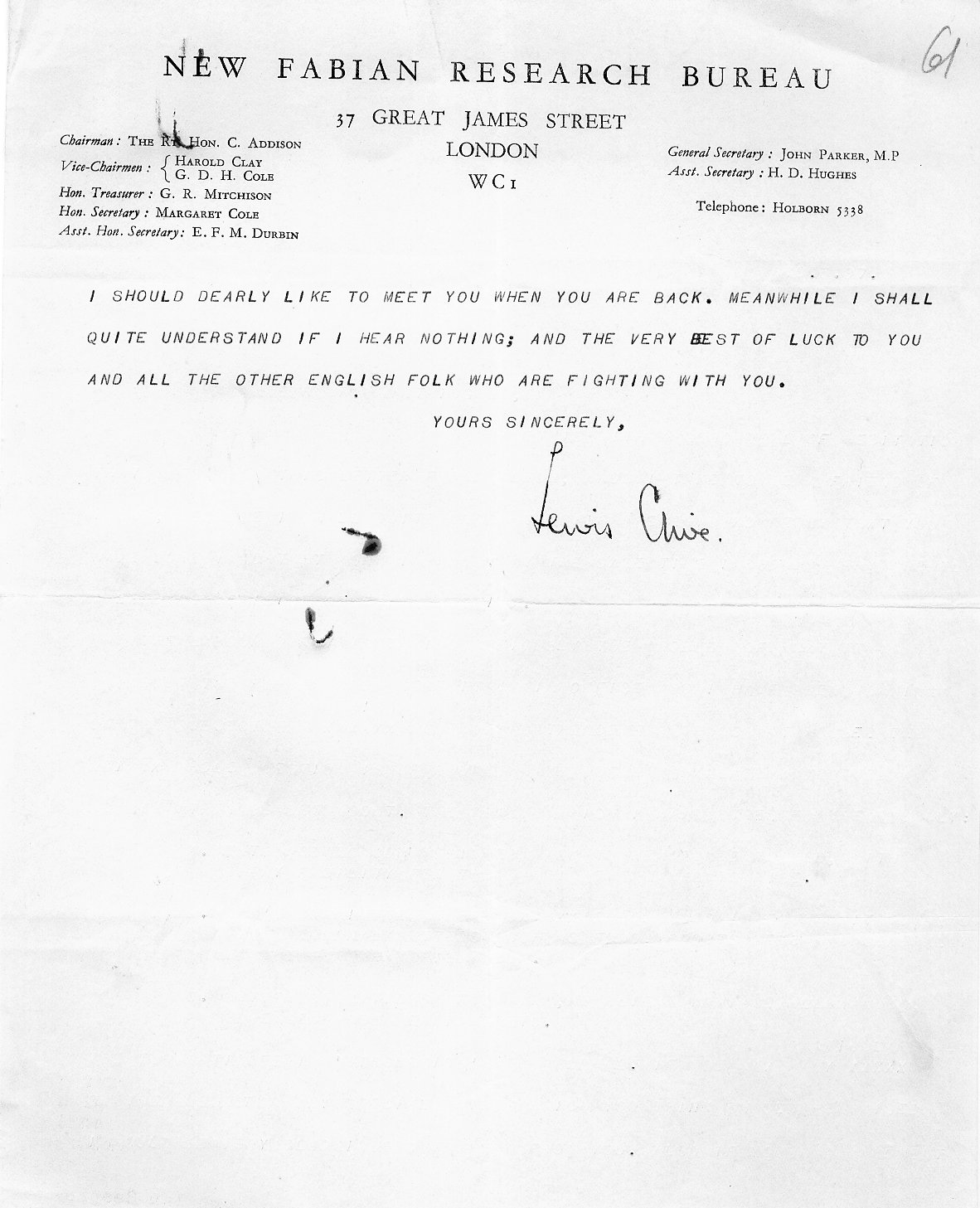
Tom Wintringham will have to wait for another blogpost, but at this point had commanded the British Battalion of the International Brigades and been wounded at the Battle of Jarama in February 1937. We don't know if he ever replied to Lewis Clive's letter, but at some point afterwards, Clive decided not to wait, but to volunteer for the International Brigades himself. He arrived in Spain in late February 1938.
 |
| Soviet Files on Lewis, incorporating International Brigades records |
 |
| "...an honest and earnest anti-fascist fighter. Should develop into a good military leader......" |
By July 1938, Clive had been promoted to command a company of the British Battalion, and had taken part in the fighting around the River Ebro. He was by now almost unrecognisable from his days as an Oxford undergraduate:
 |
| Lewis Clive in Spain, 1938. |
Around 1st August 1938, Clive was killed by a sniper's bullet. A fellow IB fighter, George Wheeler, recalled:
"Lewis Clive re-appeared and asked about the activity in the fascist lines. It was a hot, sunny day and, as usual, my shirtsleeves were rolled up. At that moment I felt splashes on my left forearm, and glancing down, was astonished to see that they were splashes of blood. Turning, I saw Lewis reel and fall. Someone below said "What a ghastly sight". I slid down from my firing position and saw that the top of his head was severed completely...This big, cheerful, and sincere man had performed his duties as Company Commander with distinction. Well-liked and respected in the battalion, this was a great loss to us all...."
Notes:
(1). Accounts of Lewis Clive's rowing career, and death in the Spanish Civil War, are set out in a very helpful blogpost, "Lewis Clive - the Red Blue" HERE. His Wiki entry is HERE.
(2). Lewis Clive's elder brother, Major Meysey George Dallas Clive (b.1907), was killed in action with the Grenadier Guards in North Africa on 1st May 1943. See more HERE.
(3). Lt-Col Percy Archer Clive is commemorated in an ornate plaque within Hereford Cathedral. It notes that he was "killed in the act of rescuing a wounded comrade".
(4). Before he left for Spain, Lewis Clive had proposed to Mary Farmer, subsequently better known as Mary Wesley, author of "The Camomile Lawn". In that novel, the character Oliver Anstey is apparently based on Clive. There is also a splendid biography of Wesley by Patrick Marnham, in which Lewis Clive features:


